

Hourly billing usually costs less for small, well-organized local moves where the crew can work fast and access is easy. Flat-rate pricing wins when your move is large, complicated, or full of unknowns you can't plan around. The safest way to know which applies to you is a written estimate built from an actual walkthrough of your home, not a guess over the phone.
TL;DR:
- Hourly rates are typically $25 to $90 per mover per hour, with a minimum booking of two to four hours, and charges are often in 15 to 30-minute increments.
- Flat-rate quotes are based on a detailed inventory walkthrough and can be either binding, non-binding, or not-to-exceed, offering more predictability upfront.
- Small, simple moves usually favor hourly billing for potential cost savings, while complex or large jobs benefit from flat-rate pricing to avoid unpredictable overages.
- Both models include potential additional fees such as stair surcharges, long-carry fees, packing costs, and fuel or toll charges, which should be clarified in writing.
- Use a pre-move walkthrough, compare written estimates side-by-side, and book on weekdays or outside peak seasons to reduce costs regardless of the chosen pricing model.
Table of Contents
- Hourly vs flat rate movers: how hourly billing actually works
- Hourly vs flat rate movers: how a flat-rate quote gets built
- Hourly vs flat rate: cost drivers, predictability, and risk
- What movers actually charge for local jobs
- How do you decide between hourly and flat rate?
- Hidden fees and red flags to watch for
- Getting a quote you can actually trust
- Ways to cut your moving bill either way
- What movers say customers actually prefer
- A straight answer on which one to book
- Book verified local movers without the phone tag
- Sources
Hourly vs flat rate movers: how hourly billing actually works
Hourly movers charge a rate per crew member, per hour, with most companies setting a minimum booking of two to four hours regardless of how fast the job goes. A two-person crew might run somewhere in the $25 to $90 per hour per mover range depending on your city and the season, plus an added travel hour to cover the drive from the mover's warehouse to your door and back.
That travel hour is where a lot of confusion starts. Some companies bill it before the crew even touches a box; others fold it into the final total. Ask which applies before you sign anything.
- Billing typically runs in 15 to 30 minute increments after the minimum is met.
- The clock usually starts when the truck arrives, not when the crew finishes parking.
- Hourly pricing gives you room to add a last-minute stop, extra boxes, or a change of plan without renegotiating a locked total.
- Crew size (two, three, or four movers) is the single biggest lever on your total hourly cost.
Hourly vs flat rate movers: how a flat-rate quote gets built
A flat rate isn't a random number. It comes from an inventory walkthrough, either in person or over video, where the mover counts your furniture, boxes, and specialty items, then factors in distance, stairs, and building access to land on one locked figure.
That figure isn't always as locked as it sounds. A binding estimate guarantees the price regardless of what happens on moving day. A non-binding estimate can shift once the crew sees the real inventory. A not-to-exceed quote gives you the best of both: it can go down if the job is lighter than expected, but it can't go up.
- Flat rates absorb the mover's own risk on traffic, fuel, and normal delays into that single number.
- The quote is only as accurate as the inventory you disclose during the walkthrough.
- Adding boxes or furniture after booking, without updating the estimate, is the most common way a flat quote gets revised upward.
- Specialty items (pianos, safes, gym equipment) almost always need to be flagged separately.
Hourly vs flat rate: cost drivers, predictability, and risk
The core difference boils down to what each model rewards. Hourly billing is time-based: you pay for however long the job takes, so efficiency saves you money and delays cost you money. Flat-rate pricing is scope-based: you're paying for a defined job, not a clock, so the total stays fixed even if the crew hits every red light in town.
- Predictability: flat-rate wins outright. You know your number before moving day starts.
- Potential savings: hourly wins when your move is small and your home is genuinely ready to go.
- Risk on delays: under hourly, a jammed elevator or a missing parking spot lands on your bill. Under flat-rate, that risk sits with the mover, a point backed by industry comparisons of how overruns hit each pricing model.
- Access and traffic problems: hourly exposes you directly; flat-rate insulates you.
If your move has more than one variable you can't control, prioritize predictability over the chance of a lower hourly bill. If your home is small and genuinely ready, hourly is usually the better bet.
What movers actually charge for local jobs
A two-bedroom apartment with a two-person crew at an hourly rate and a four-hour minimum, typically lands between a low and moderate total once travel time is added. That's the kind of number you should be seeing on a written hourly quote before booking.
Flat-rate totals for the same kind of job tend to run higher on paper, often landing in a range notably above typical hourly totals for a comparable local apartment move, because the mover prices in the risk of everything going wrong, not just what typically happens.
- 1-bedroom apartment: light inventory, easy access. Hourly often wins here, sometimes by $100 or more, since the job wraps inside the minimum window.
- 3-bedroom family home: heavier inventory, multiple stops, unpredictable stairs or elevator waits. Flat-rate frequently wins because a hard-to-predict hourly job can run long fast.
Rates shift with the calendar too. Expect higher hourly and flat quotes during summer weekends and month-end, when demand for local movers spikes in most metro areas. Neither model is immune to seasonal pricing, but flat-rate quotes tend to bake that surge into the number upfront rather than surprising you with it later.
How do you decide between hourly and flat rate?
Run through this before you book anything:
- How much stuff do you actually have, room by room?
- Is your building easy to access, or does it involve stairs, a long carry, or elevator scheduling?
- Will everything be packed and ready when the crew arrives, or are you still figuring that out?
- Are you making one stop or several (storage unit, second address, donation drop)?
- How much uncertainty can your budget tolerate if the job runs long?
- How far is the move, even within the same city?
If most of your answers point to small, simple, and ready, hourly is your better bet. If several answers point to large, complex, or uncertain, a flat rate protects you from a bad surprise.
Pro Tip: If you lean toward hourly but want a safety net, ask the mover for a not-to-exceed cap on your quote. It behaves like an hourly rate with a built-in ceiling, so you keep the upside without the risk of an open-ended bill.
Hidden fees and red flags to watch for
Both pricing models come with add-ons that can inflate a bill if nobody mentions them upfront.
- Stair and elevator surcharges for buildings without direct truck access.
- Long carry fees when the truck can't park close to your door.
- Shuttle charges if a smaller vehicle is needed to reach your unit.
- Packing material costs if you didn't supply your own boxes and wrap.
- Fuel, tolls, and extra-stop fees for detours added after the quote.
Walk away from any mover who won't put an estimate in writing, gives vague answers about when the hourly clock starts, or can't produce proof of insurance. Consumer guidance is consistent on this point: insist on an itemized written estimate and keep every document the mover gives you, including a signed change order if the scope shifts on moving day.
Getting a quote you can actually trust
- Walk through your home room by room and photograph anything unusual, heavy, or fragile before the mover ever shows up.
- During the walkthrough, ask specifically about parking distance, elevator booking windows, stair counts, and how those factors get billed.
- Line up two written estimates side by side and check that both cover the same inventory, the same access conditions, and the same start time, not just the same bottom-line number.
- On moving day, have boxes packed, furniture disassembled, and a clear path to the door so nothing adds unplanned time to the clock.
A short virtual walkthrough with clear photos often produces a quote just as accurate as an in-person visit, provided you disclose specialty items and show the mover your building's access conditions honestly.
Ways to cut your moving bill either way
Small preparation choices save real money under both pricing models.
- Pack everything and label boxes by room before the crew arrives, and disassemble bulky furniture yourself if you're comfortable doing it.
- Reserve visitor parking or book elevator time in advance so the crew isn't standing around waiting.
- Ask for a capped hourly rate or a not-to-exceed flat quote if you're unsure which way your move will trend.
- Book on a weekday or outside peak summer weekends, when demand and pricing typically ease up.
Pro Tip: A verified booking platform lets you compare a few transparent offers side by side in minutes, which beats calling five companies and hoping their quotes are even comparable.
What movers say customers actually prefer
Preferences split pretty predictably along move size, and the pattern shows up in how moving companies structure their own default pricing. Smaller local movers, the kind handling single rooms, studio apartments, or small households, tend to default to hourly pricing because customers in that segment consistently ask for it. They want the option to end the job early if it goes faster than expected, and they're comfortable with a bit of billing variability in exchange for a shot at a lower total.
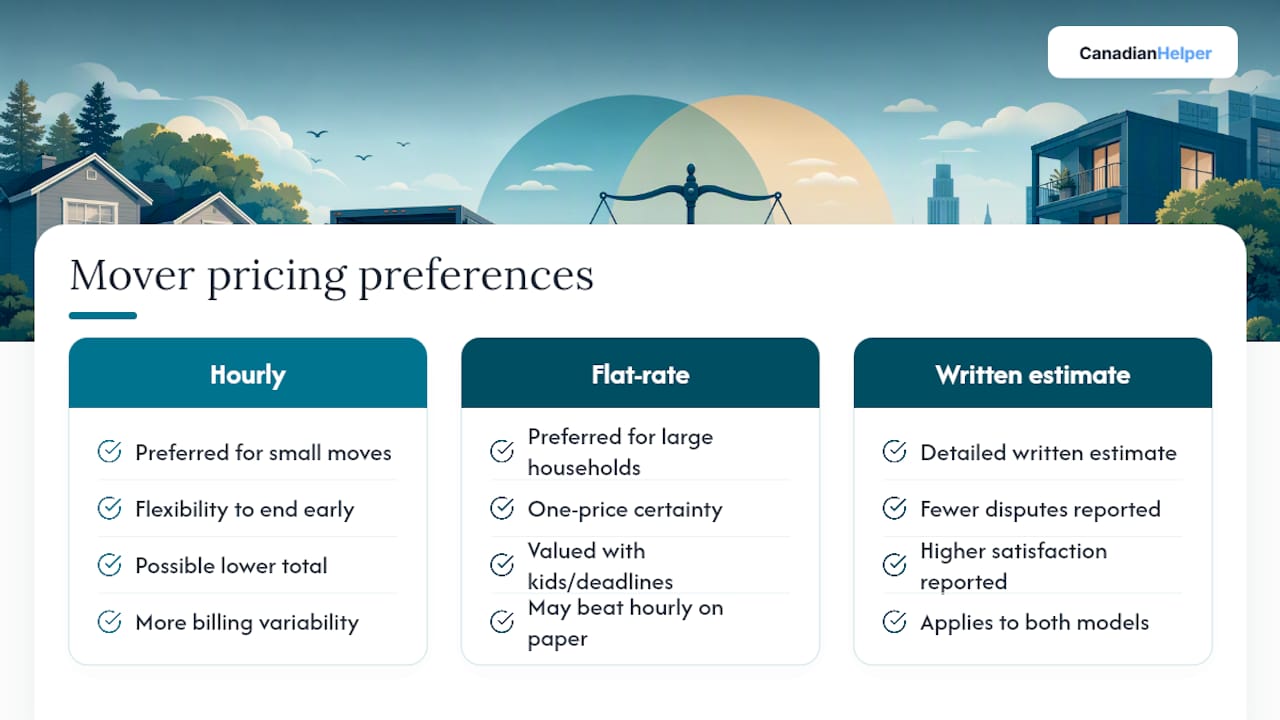
Larger households behave differently. Families with a full three or four-bedroom home tend to gravitate toward flat-rate quotes even when the hourly math might come out slightly cheaper on paper, because the certainty of one number is worth more to them than the chance of shaving off a bit extra. Nobody wants to discover mid-move that the job is running two hours longer than expected with a toddler in tow and a lease deadline looming.
Satisfaction tends to track less with which model someone chose and more with whether the estimate they received matched the bill they got. Customers who received a detailed written estimate, whether hourly or flat, report fewer disputes and higher satisfaction than those who booked off a vague phone quote. The complaint pattern is consistent across both pricing types: it's rarely the model itself that frustrates people, it's the gap between what they expected to pay and what actually showed up on the invoice.
A straight answer on which one to book
Small, tidy local move with easy access? Book hourly and prepare well to keep the clock short. Big, complicated, or unpredictable move? Pay a bit more for a flat rate and buy yourself certainty. Either way, get the written estimate first and read it before you sign anything.
— Yasir
Book verified local movers without the phone tag
Comparing hourly and flat-rate quotes usually means calling several companies, repeating your inventory over and over, and hoping the numbers you get back are even measuring the same thing. Some platforms offer marketplaces built for exactly this kind of decision: local moving providers listing transparent pricing upfront, so you can compare hourly rates and flat-rate quotes side by side without a single negotiation call.

Because every provider on the platform is reviewed and vetted, you're not gambling on a stranger's word about insurance or hidden fees. You see the pricing model, the reviews, and the details before you commit, then book in a few clicks. If your move is coming up, check available local movers on Canadianhelper and get a transparent quote before you lock in a date.